
Dear Reader,
It’s Sunday. It’s a beautiful bright day outside and Spring is definitely hiding around the corner, maybe even peeking at us every now and then. I’ve been for a lovely walk this morning and now I’m back to sitting on the sofa thinking ‘what shall I do next?’
If you’re like me and find that you’re struggling to keep yourself entertained during Lockdown, why not try teaching yourself something new? there’s only so much banana bread you can bake after all, isn’t there. Ever since watching Disney’s Hercules as a kid I’ve always had an interest in Greek Mythology. Unfortunately, the real stories behind legends such as Hercules don’t end in the same happy endings that we’ve grown to love. I just want to say that many of the stories within Greek Mythology do tend to vary, so if you’ve heard something slightly different from what I’m about to write then don’t worry, your version is still valid. There is no definitive right or wrong way to tell this, which I love. You might want to grab yourself a few snacks, we could be here a while.
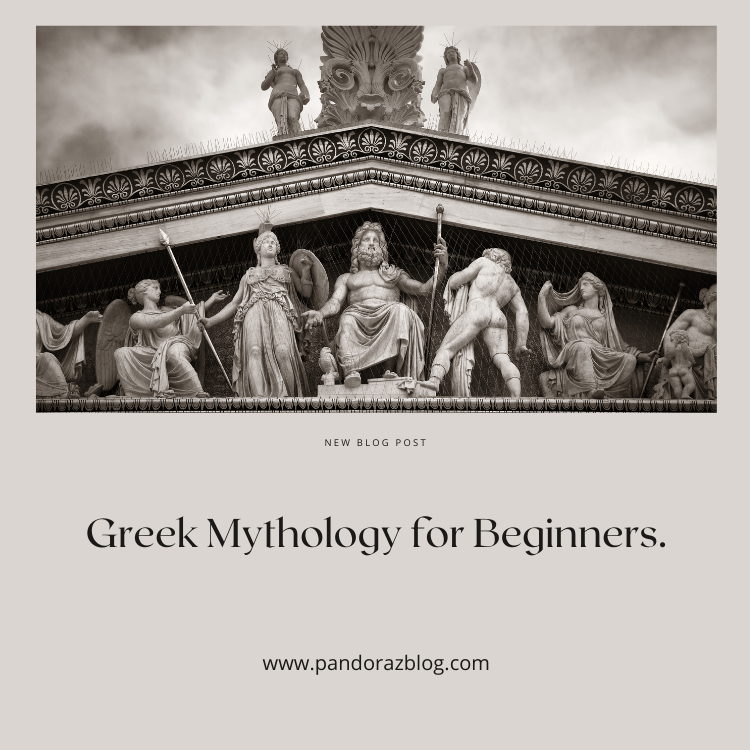
Where to begin? You’ve most likely heard of the movie Clash of Titans. Well, I’m not going to talk about that movie, but I am going to briefly talk about the Titans because they play a pretty integral part in the foundations of greek mythology. The Titans were immortal giants with incredible knowledge of magic and strength who ruled the world before the Olympians (we’ll get to them later). They were also known as the Elder Gods and they resided on Mount Othrys. Unlike other civilisations such as the Egyptians, the Greeks made their Gods in their own image. That’s why in most depictions of Greek Gods and Goddesses they appear to be beautiful and muscular, as opposed to having the head of a fish and the body of a lion. So on some scale, we all kind of look a bit like Greek Gods. Just don’t let it go to your head.
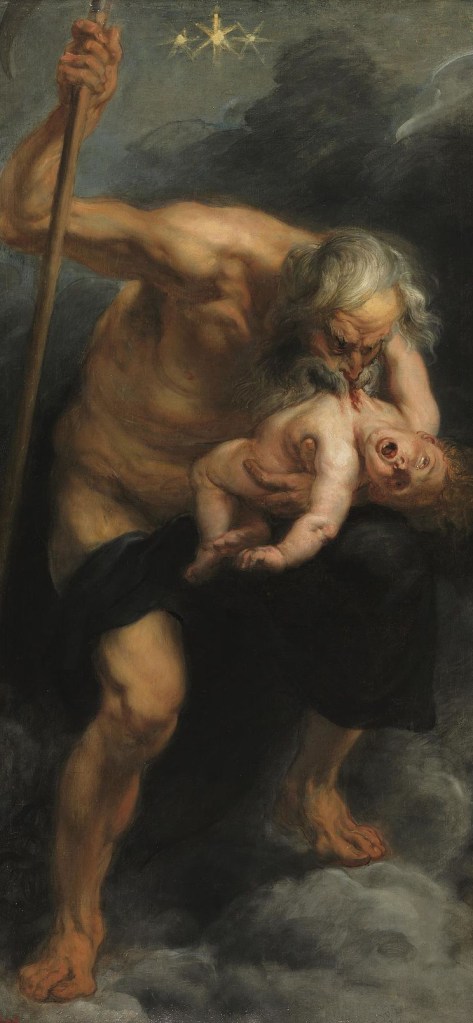
Okay, so maybe looking like a Greek God isn’t so great after all. This guy here is Cronus. Or Kronos. Or Cronos. See what I mean? Variations. Today we’re going to stick with Cronus, but if you decide to read about greek mythology elsewhere, any version of that name is fine. You might wonder what the f*ck is going on here, and you’d be very right to think that. So I’m going to explain who this dude is.
Cronus was the leader of the first generation of the Titans. He was the descendant of two Primordial beings, Uranus; the personification of the sky, and Gaia; the personification of the Earth and the ancestral mother of all life. Between them, Uranus and Gaia birthed the first giants and Titans that we have come to know, including the likes of Oceanus who was the lord of the river Ocean; a great river encircling the Earth. However, Uranus grew concerned that his powerful offspring would one day overthrow him and so he cast his offspring into the depths of Tartarus. Tartarus is basically the Underworld and the equivalent to our Hell. It comes up a lot in Greek Mythology. Anyway, understandably Gaia was extremely pained by this. I mean, her children were being held captive, even a Goddess would be pretty bummed out. So, what did Gaia do? Did she confront Uranus and tell him how she felt? Did they go to marriage counselling for Gods and Goddesses? I know the suspense is killing you, so I’ll spill the beans. She conspired against her significant other and plotted for him to be castrated by one of his own sons. And which son, do you ask? Good old Cronus. He definitely sounds like a Mummy’s Boy.
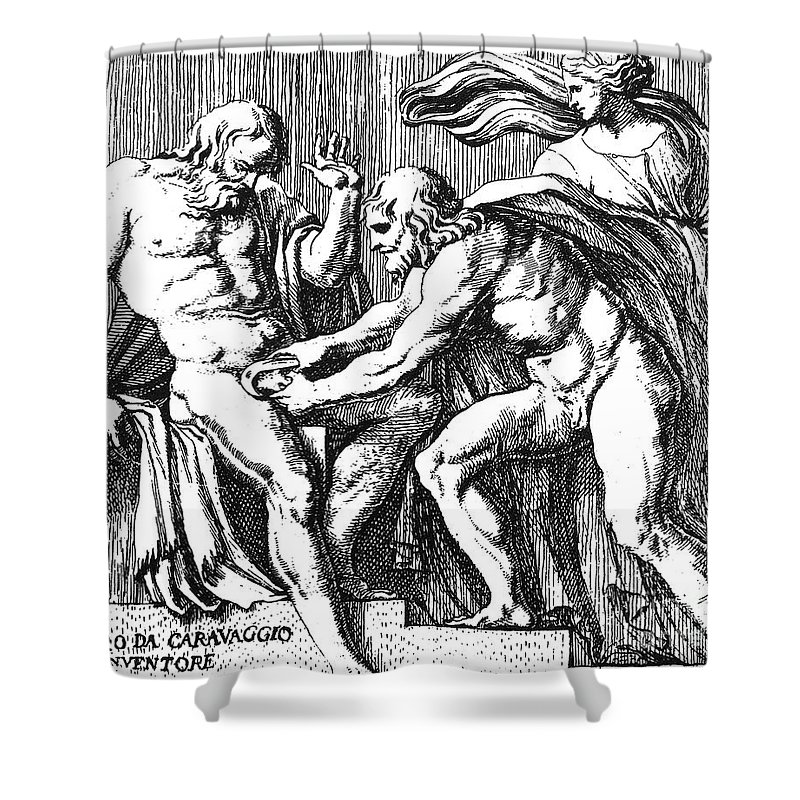
Cronus wounded his father, and with the blood that shed from his wound and fell onto the earth sprouted a new race of beings, also called Giants. Cronus enlisted his fellow Titan siblings and together they managed to dethrone their father. Enraged by this, Uranus cursed his son with a similar fate and suggested that he would be overthrown by his own children. You can see where this is going right? Filled with great power, Cronus treated his siblings like his subordinates and once he had secured the throne for himself and no longer needed them, he made war upon his brothers and allies with the assistance of the giants and he defeated them. Any who resisted him were immediately sent into Tartarus. Talk about family feuds, I wouldn’t want to be at one of their reunions.
I’m going to move onto the next part of this tale involving Cronus, so if you’d like to know more about the other Titans, please check out this link.
http://www.talesbeyondbelief.com/myth-stories/uranus-gaia.htm
Now, we can already tell that Cronus is going to have some serious trust issues given that his own dad has cursed him. The idea of being overthrown by his own children simply was not going to happen. Cronus wound up marrying one of the other Titans, Rhea. If you don’t already know anything about Greek Mythology or haven’t read the little link above, you may not make the connection that Rhea is in fact Cronus’ sister. There is a hell of a lot of incest in Greek Mythology, however as these are incredibly powerful divine beings the act of reproduction is not like that as we know. It isn’t just the act of a sperm cell penetrating an egg, it’s to do with the transformation of energies and essences. Some may argue that the greeks depicted their Gods in this way to make incest in every day life more acceptable. Whatever helps them sleep at night.
Rhea was informed of the prophecy that Cronus believed to be true, however the two produced six offspring. The first child was Hestia, known as the virgin goddess and the goddess of the family/home. To Rhea’s horror, Cronus devoured his child in an attempt to prevent the curse set upon him by his own father from becoming a reality. His second daughter Demeter met the same fate, followed by Hera, Hades and Poseidon.
Hestia
The virgin goddess, goddess of the hearth and the home.
Demeter
The goddess of the harvest and agriculture, known for her fertility of the earth.
Hera
The goddess of women, family, marriage and childbirth.
Hades
The god of death and king of the underworld.
Poseidon
The god of the sea, storms, earthquakes and horses.
Zeus
The god of thunder and the sky.
As these children were Gods and this is Greek Mythology so obviously all natural laws of physics go out of the window, the five children were in fact still very much alive in Cronus’ stomach. So far Cronus believed his plan to be working, however Rhea was growing increasingly unhappy at the loss of her children. When she gave birth to her sixth child Zeus, she decided that enough was enough and turned to Gaea for relief. They came up with a plan to trick her husband. When the time came for Cronus to chow down on his third son, Rhea in fact wrapped up a rock and gave it to him. Cronus didn’t stop to inspect the bundle and guzzled the package down in one, leaving baby Zeus alive and well. Rhea had in fact given birth to Zeus in a cave on the island of Crete, where he was to live in hiding from his father.
It’s said that Zeus was cared for by a Nymph named Amalthaea and guarded by the Curetes, young warriors who would clash their weapons together in an attempt to disguise the cries of the infant. When Zeus was of age, he returned to rescue his siblings. He did this by poisoning his father who would then regurgitate the five fully grown offspring who had been residing in his stomach. It’s unclear as to how exactly Zeus poisoned his good old dad, but from what I can gather he spiked his wine with vomiting poison. Cover your drinks ladies. Once Zeus had freed his siblings, they left and began to come up with a plan to overthrow their father.
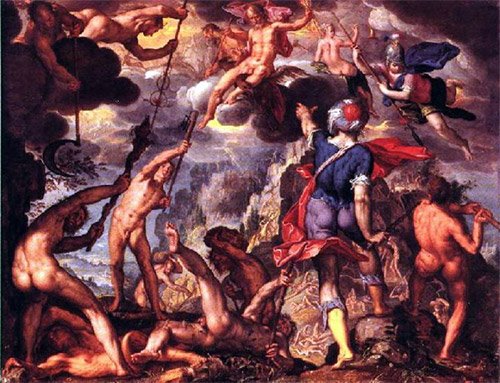
Zeus rebelled against Cronus, along with all his brothers and sisters, and so began a war that would span across 10 years. This battle would be known as the Titanomachy and was fought to determine which generation of Gods would have dominion over the universe. Zeus had enlisted the support of the Cyclops who Cronus’ had previously cast into Tartarus. The Cyclops were giant one-eyed creatures and were especially well known for their profound forgery and crafting skills. It was in fact the Cyclops who created weapons for the ‘big three olympians’. A sickle for Hades, a trident for Poseidon, and a thunderbolt for Zeus. It was with these weapons and the support of the Cyclops that the children of Cronus’ managed to win the war against the Titans. They dubbed themselves as the Olympian Gods, named after Mount Olympus where they resided and became the new rulers of the Cosmos.
All that was left was for the Gods to split the responsibilities of who was to rule where. Once again, it is slightly unclear as to how this was decided but supposedly the Gods drew straws. Maybe this is where the idea of pulling straws came from. Zeus knew that as Hades was the eldest brother, he would have had the first pick over where to rule. He managed to persuade his brothers to draw straws, and unlucky for Hades he drew the short straw, being that he would be the ruler of the underworld. Followed by Poseidon, who would rule the kingdom of the sea and Zeus who came out as the winner and therefore ruling the skies and becoming the King of Gods and inheriting the command over the heavens.
I don’t know about you, but I think that’s a good place to put a pin in this for now. Greek Mythology contains so many different stories and names, I think we need a bit of a breather. Next time I’ll research a bit more into the Big Three Olympians and the others who I haven’t mention as of yet. If there’s anything you want me to cover or anything I’ve missed out just pop me a little comment!
Until next time
H x







 Pandora'z Blog